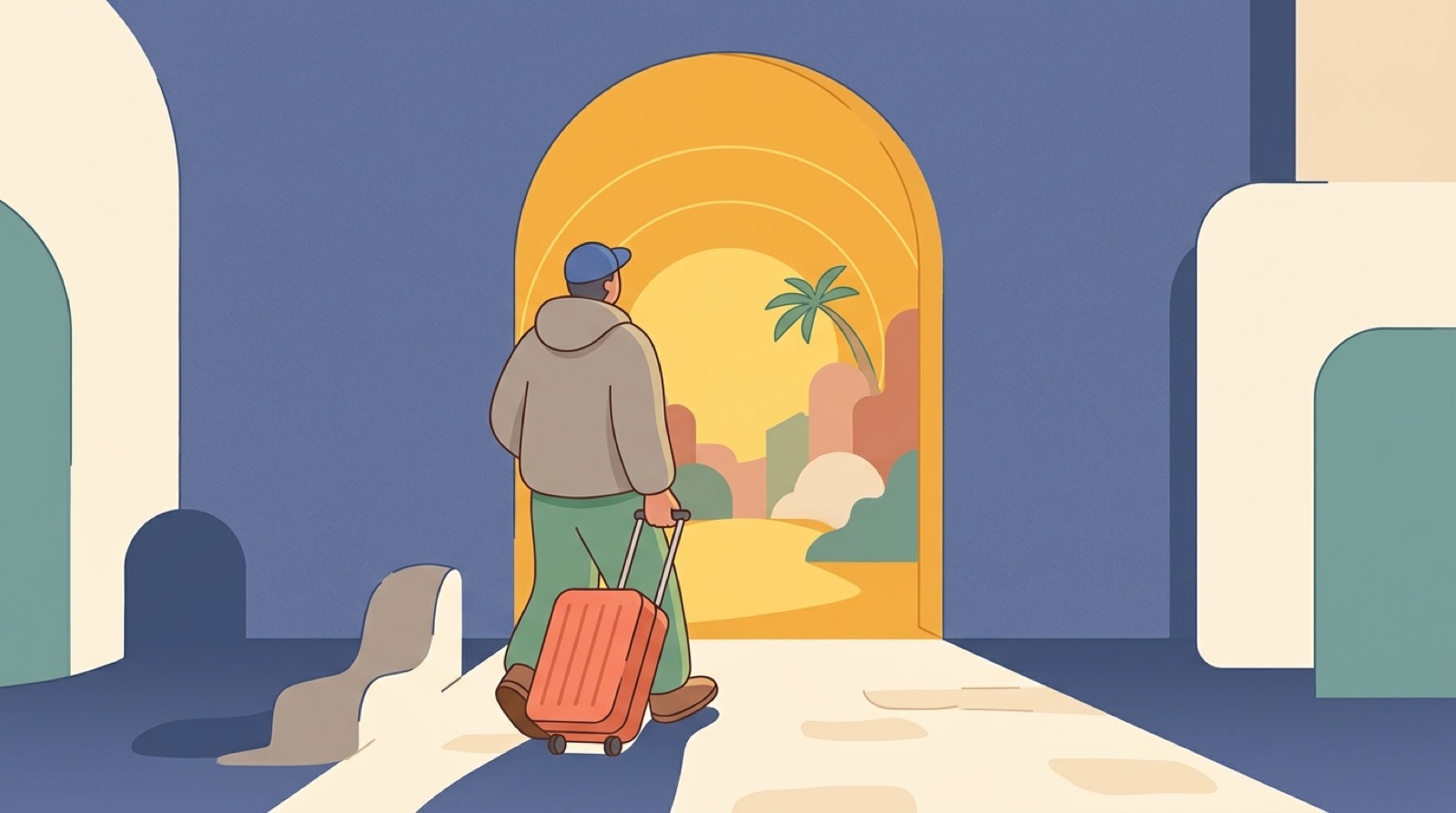
Most flight anxiety isn't spent on planes. It's spent in the days before — the sleepless night, the weather-app checking, the quiet math about whether you could still cancel. Psychologists call it anticipatory anxiety, and for many nervous flyers it's genuinely worse than the flight itself.
That's actually good news, because anticipatory anxiety responds beautifully to preparation. Not the white-knuckle kind — the specific kind. Anxiety feeds on the unknown and the unplanned; every box you tick below removes a piece of its fuel.
Why preparation beats willpower
Trying to be brave on the day is a strategy that asks the most of you at your worst moment. Preparation flips that: it does the work while you're calm, so there's less alarm to manage when it counts. Rehearsed situations register as less novel, and your brain fires less alarm at familiar things. A plan also gives your prefrontal cortex — the calm, rational part — a job to do, which is precisely the part of the brain that anxiety tries to shove offstage.
Managing anxiety before flying, in other words, is mostly done before the airport. Here's the timeline.
The week before: retrain, don't ruminate
- Practice ten minutes a day. One reframed thought, one breathing exercise, daily. Spaced practice is how the nervous system actually learns — a week of small sessions beats a panicked hour at the gate. This is exactly what ReadytoFly's daily sessions structure for you, matched to your specific triggers.
- Learn your two facts. Pick the fear that loops loudest and pre-load the answer: if it's the bumps, read what turbulence actually is; if it's "what if something goes wrong," read the real safety statistics. One accident per 880,000 flights reads differently when you've absorbed it calmly at home.
- Choose your seat deliberately. Over the wing is the aircraft's center of gravity — the physical motion of turbulence is smallest there. Aisle if you feel trapped, window if outside reference calms you.
- Kill the logistics unknowns. Check in online the moment it opens, screenshot your boarding pass, know your terminal. Every solved logistic is one less spinning thread at 2 a.m.
- Rehearse once, start to finish. Close your eyes and walk the whole flight: bag drop, security, boarding, taxi, takeoff, cruise, landing. Visualization isn't wishful thinking — it's exposure practice, and it makes the real day feel like the second time.
The night before a flight: what to do if you have flight anxiety
The night before is where preparation is won or lost, because sleep deprivation amplifies next-day anxiety more than almost anything else.
- Pack early, set everything out. Clothes, documents, charger — done by dinner. Rushing in the morning spikes adrenaline before you ever leave the house.
- Don't check the turbulence forecast. Forecasts can't tell you anything a fastened seatbelt doesn't already handle, and doom-scrolling weather maps is reassurance-seeking — it feeds the loop it promises to calm.
- Pack a small calm kit. Headphones, water bottle to fill past security, gum or mints for pressure changes, and the ReadytoFly tools downloaded — everything works in airplane mode, so the toolkit boards with you.
- Cut caffeine after noon; skip alcohol entirely. The nightcap trade is terrible: an hour of drowsiness for fragmented sleep and a jumpier morning. (The full story is in our guide to flying without medication.)
- Fall asleep on a long exhale. In bed: inhale 4, hold 7, exhale 8, repeated gently. It's the fastest lever you have on a racing heart, and it works better than lying there negotiating with tomorrow.
The morning of: keep the baseline low
- Eat a real breakfast, skip the coffee. Caffeine's racing heart is anxiety's racing heart — your brain can't tell the difference, so it assumes the worst. Protein and water keep blood sugar (and mood) steady.
- Leave earlier than feels necessary. A rushed connection is a panic head-start. Arriving with an hour to spare keeps your baseline where the tools work best.
- Move while you wait. Walk the concourse instead of marinating in the gate chairs. Light movement burns off adrenaline and settles the body's threat math.
- Run one session before boarding. Ten minutes with your program at the gate — one reframe, one breathing round — is the warm-up lap that makes the flight itself familiar territory.
On board: the in-flight protocol
- Tell the crew. A ten-second "I'm a nervous flyer" at boarding buys you a calm ally who explains sounds honestly and checks on you in bumps. They do this every single day.
- Set your base: seatbelt snug, feet flat on the floor. The belt removes the only real turbulence risk; grounded feet give your nervous system a physical anchor.
- Breathe through takeoff on purpose. Takeoff is 30–45 seconds of maximum noise and sensation. Start box breathing (4-4-4-4) as the engines spool, and let the technique carry you to cruise.
- When turbulence comes, run the script. Belt check, feet down, long exhale, and the reframe you rehearsed: bumpy air, engineered for, completely safe. Watch the flight attendants pouring coffee for your reality check.
- Use the tools, not the forecast. Everything in ReadytoFly's toolkit works offline in airplane mode — grounding, breathing, thumb-tap — because mid-flight is exactly when you need help to be two taps away.
Your countdown, structured for you
Tell ReadytoFly your triggers and it becomes the daily prep routine — short sessions before the trip, offline tools during it.
The flight anxiety checklist, condensed
Week before: daily 10-minute practice · learn your two facts · seat over the wing · online check-in · one full mental rehearsal.
Night before: packed by dinner · no forecasts · calm kit ready · no alcohol, no late caffeine · 4-7-8 to sleep.
Morning of: real breakfast, no coffee · leave early · walk, don't sit · one session at the gate.
On board: tell the crew · belt snug, feet flat · breathe through takeoff · run the turbulence script · tools in airplane mode.
Frequently asked questions
This article is for informational and educational purposes only. ReadytoFly is a wellness program, not a substitute for professional medical or psychological treatment. If you are experiencing severe anxiety, please consult a licensed mental health professional.